
Knowledge graph
A map of everything you know.
Every note Recolo captures joins a graph of the people, projects and ideas in your life. Over weeks it becomes a mind you can read, and ask.
Why a graph and not a list
Notes apps keep notes in lists and folders, which answers one question well: where did I put it? They do badly at the questions that matter later. What do I know about this client? Which conversations touched this decision? Who did I talk to about hiring? Those answers live across many notes at once, and a folder cannot hold a note in several places.
A knowledge graph can. Each note becomes a point joined to the people, organisations, projects, topics and ideas inside it. A single meeting sits beside the client it was with, the project it concerned and the decision it changed. Ask about any one of them and the whole neighbourhood comes back.
Built from what you said, not what you filed
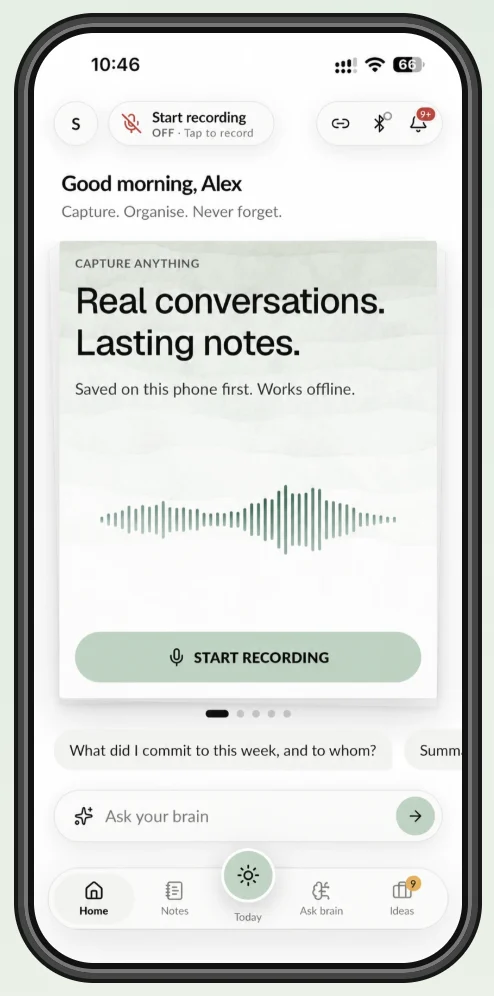
Recolo builds the graph for you. When a meeting, a voice note or an article is captured, the brain reads it, finds what it mentions, and links it to everything already there. A person who comes up in three calls and a voice note is one node with four conversations behind it. Nothing is tagged by hand, and nothing has to be kept tidy, which is the difference between a second brain that lasts and one that is abandoned.
Regions: a mind you can read
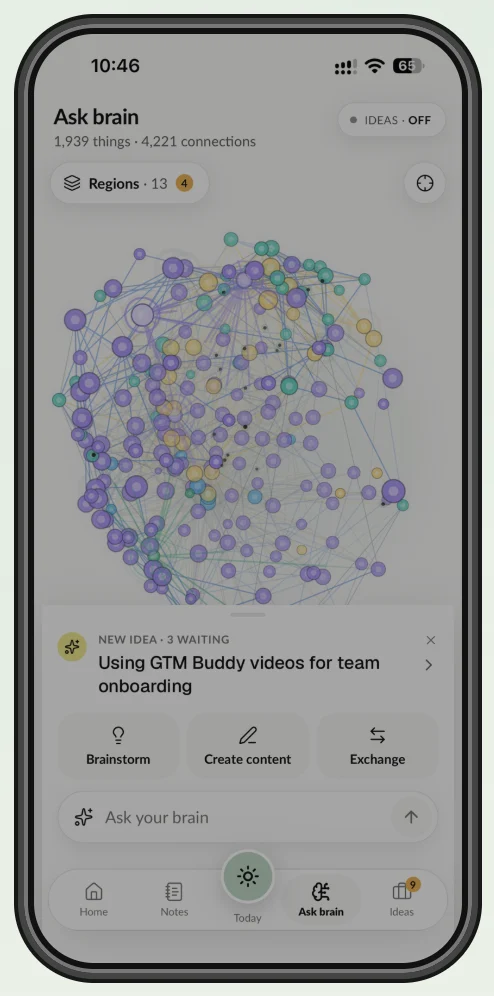
A graph of thousands of points is not readable on its own, so Recolo groups it. Clusters of notes that keep touching the same people and ideas become regions, named by the brain itself: "Enterprise strategy", "Hiring", "The house move". One glance at the Ask Brain screen shows what your mind has been circling this month. You can rename a region, pin your own, or ask for ideas about one.
Answers from the whole graph
Ask Brain is a question put to the graph. It finds the people, topics and conversations your question touches, reads the notes behind them, and answers in plain words with the sources listed underneath. Because the graph links across time, "What did I promise Maya?" is answered from every call with Maya, not the last one.
What the graph does while you rest
- Ideas appear where two parts of the graph touch that you had not connected: a problem from one meeting and an answer from an article a month earlier.
- Reminders come from the commitments the brain found in your conversations.
- The Studio writes documents, presentations and posts from a region of the graph rather than a blank page.
- Other assistants such as Claude and ChatGPT can search the graph through Recolo's MCP connector, when you ask them to.
Questions about the knowledge graph
What is a personal knowledge graph?
A personal knowledge graph is a map of what you know: the people, organisations, projects, topics and ideas in your life, and the links between them. In Recolo it is built from your conversations and reading, and every answer is drawn from it.
Do I have to build the graph myself?
No. Recolo reads every note you capture, finds the people, projects and topics in it, and links them. You can rename or pin a region, but nothing has to be made by hand.
What are regions?
Regions are the groups the brain finds in your graph: clusters of notes that keep touching the same people and ideas, named by the brain itself, such as "Enterprise strategy" or "House move". They are a readable table of contents for your own mind.
How is a knowledge graph different from folders?
A folder holds a note in one place. In a graph, one meeting sits beside the client it was with, the project it concerned and the decision it changed, all at once. That is what lets Recolo answer a question about a person from every conversation you ever had with them.
Can I see the graph?
Yes. The Ask Brain screen shows your graph under the ask box, with every dot a thing you have talked about and the regions the brain has named. New connections appear while the page is open.
Coming soon
Be among the first
to remember everything.
Recolo is launching soon. Leave your name and we write the day it is out.
Your first name and email, nothing else.